Helping Hand offers home care services and in-home support to help older people stay independent, safe and connected at home across metropolitan Adelaide and regional South Australia. Support can include domestic assistance, personal care, transport, nursing, allied health and social connection.
Helping Hand Retirement Living supports people who want to live independently in a lower-maintenance home while staying connected to a friendly community. Villages are located across South Australia and may suit people who are ready to downsize while keeping their independence.
Helping Hand provides 24-hour residential aged care in 11 care homes across metropolitan Adelaide and regional South Australia. Residents are supported with personal care, nursing, meals, lifestyle activities and dementia support in a safe, welcoming environment.
Explore aged care careers, volunteering and student placements with Helping Hand, a South Australian not-for-profit supporting older people across home care, retirement living and residential care.
Helping Hand offers home care services and in-home support to help older people stay independent, safe and connected at home across metropolitan Adelaide and regional South Australia. Support can include domestic assistance, personal care, transport, nursing, allied health and social connection.
Helping Hand Retirement Living supports people who want to live independently in a lower-maintenance home while staying connected to a friendly community. Villages are located across South Australia and may suit people who are ready to downsize while keeping their independence.
Helping Hand provides 24-hour residential aged care in 11 care homes across metropolitan Adelaide and regional South Australia. Residents are supported with personal care, nursing, meals, lifestyle activities and dementia support in a safe, welcoming environment.
Explore aged care careers, volunteering and student placements with Helping Hand, a South Australian not-for-profit supporting older people across home care, retirement living and residential care.
Helping Hand offers home care services and in-home support to help older people stay independent, safe and connected at home across metropolitan Adelaide and regional South Australia. Support can include domestic assistance, personal care, transport, nursing, allied health and social connection.
Helping Hand Retirement Living supports people who want to live independently in a lower-maintenance home while staying connected to a friendly community. Villages are located across South Australia and may suit people who are ready to downsize while keeping their independence.
Helping Hand provides 24-hour residential aged care in 11 care homes across metropolitan Adelaide and regional South Australia. Residents are supported with personal care, nursing, meals, lifestyle activities and dementia support in a safe, welcoming environment.
Explore aged care careers, volunteering and student placements with Helping Hand, a South Australian not-for-profit supporting older people across home care, retirement living and residential care.
Home/The Intergenerational Play Group sparking joy at Ingle Farm
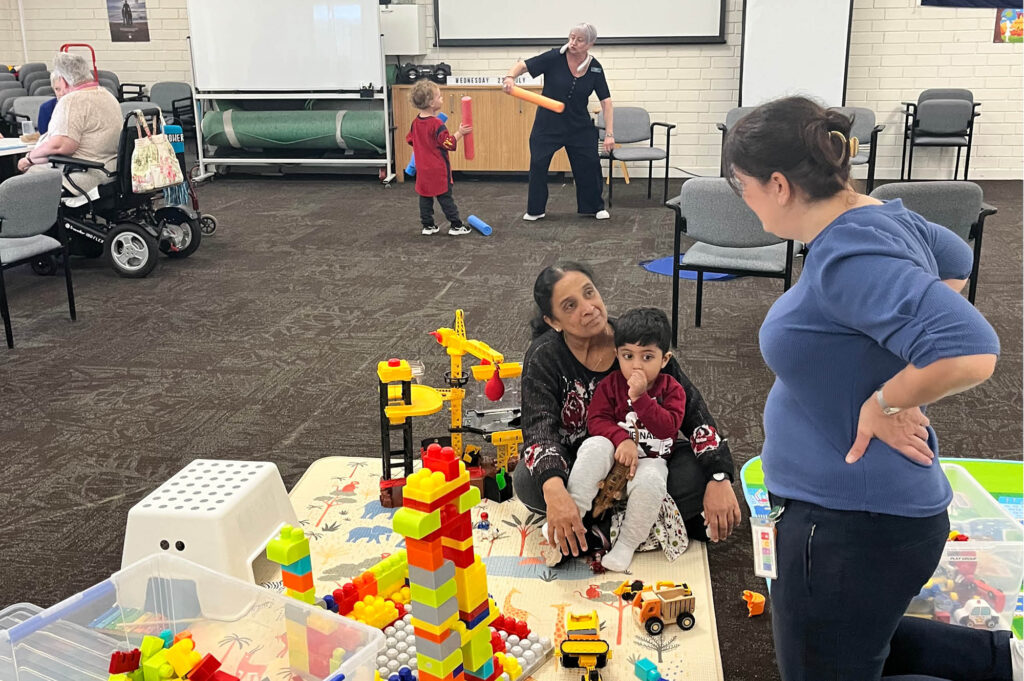
On one side of the room, a four-year-old boy is giggling with glee as he defends himself with a pool noodle (or three) against the swipes coming his way from a grey-haired friendly foe.
In the middle of the room is a mat patterned with palm trees and animals, scattered with toy cars, marble towers and brightly coloured Duplo. A shy but happy boy sucks his thumb while seated on his grandma’s lap, occasionally rising to build something new.
Along the back wall, several balloons bounce up and down the length of a table, propelled by a mix of bare hands and pool noodles. A young man in an orange t-shirt ensures that everyone seated at the table has a chance to participate, and the smiles they give are plentiful.
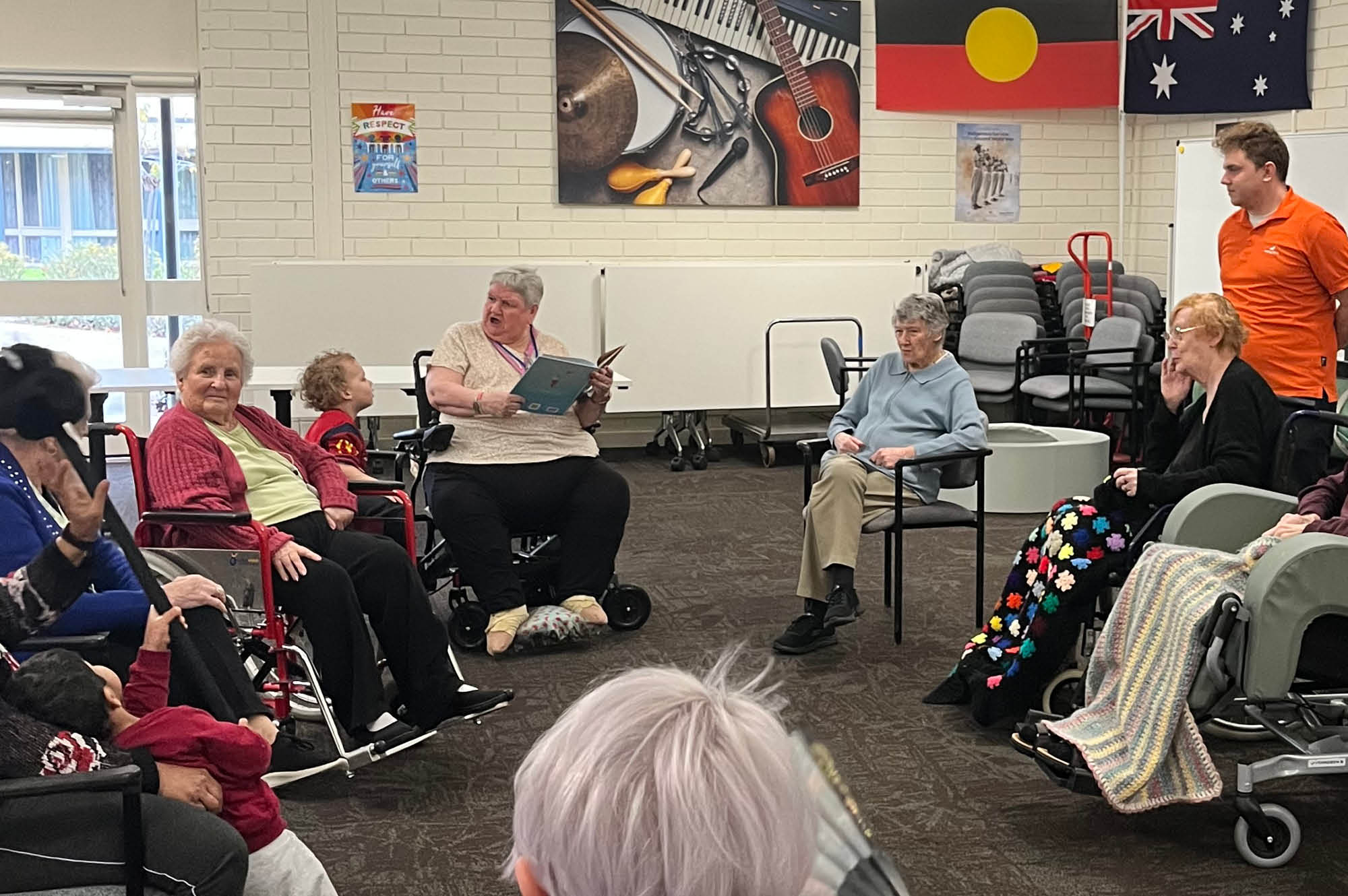
This is Ingle Farm Residential Care Home on a Wednesday Morning. The Lifestyle Team cater for the residents and a playgroup which has been up and running for around 18 months now. It’s a morning that everyone looks forward to.
A mainstay of the intergenerational playgroup is Theo, the four-year-old who was busy in battle. Ingle Farm is home to two of his great-grandmothers, making him a fourth-generation connection. His grandparents, Anne and Wayne, bring him in each week to have a play and spend time with family.
“Sometimes it’s really structured,” says Anne, “and other times it’s a bit freestyle. The mats are always out though. They play noodle-soccer, quoits, and sometimes skittles when it’s a smaller group. Often, we’ll buy Theo a fruit salad from the café so he can eat when the residents do.”
“He loves chatting to them all and has different relationships with each. When he can’t remember their names, he calls them grandma and grandpa. Last week he had lots of grandpas,” she says with a smile.
Conversation is pleasantly interrupted by music, just loud enough for the residents and children to sing along to. They become a chorus of “one little finger, tap, tap, tap” replete with actions. Again, the smiles are many, even on the faces of those who choose to watch.
Cynthia, one of the most enthusiastic singers, is also resident reader. Once the music stops, she moves her wheelchair to the top of a rough circle of chairs and pulls out a book. Story time is a clear favourite for Theo, who drags a chair as close as possible and provides expert commentary throughout her wonderful, animated delivery. He’s not the only one transfixed, though. All residents join the circle, and it’s hard to say who is the most invested in finding Little Bear by the end of the story.
According to Anne, the play group is a wonderful way to bring her mother Dorothy (92) out of her room in the Memory Support Unit, where she often keeps to herself.
“She lights up when it comes to Theo, and she loves chatting to him about cars and animals. I’m so grateful to the Lifestyle Staff. They make themselves very available, and they problem-solve. As an ex-nurse, I can also confirm that the nurses here are really good. The volunteers are the icing on the cake.”
Like Theo’s grey-haired friendly foe. Her name is Lynn, and she’s been volunteering for about six months. “I love chatting with absolutely everyone here, young and old,” she says. “I’m a hands-on grandma, so I’m hands-on with the children here. And I love the rapport I have with the older people. They have so much to tell me about. Sometimes their careers completely blow me away. Being in their company is humbling.”
Lifestyle assistant, Braydn, admits he was a bit nervous about working with children when playgroup first started. You wouldn’t think it seeing him in action. He too is great with all ages. Asked what he loves about having the children on-site, he says it “brings out the kid in the residents, along with lots of smiling and laughing.”
Wayne’s Mum Maureen is also 92. She loves watching the children play. “It’s a pity more don’t come,” she laments.
In good news, they absolutely can. The team at Ingle Farm would love to welcome more children each week. If you have family, friends, or acquaintances who might be interested, please invite them to join in the fun. They can get in touch via phone 1300 653 600 or email.
The weekly sessions run on Wednesdays during school terms from around 10:00 am to 11:30 am.
Home/From Kuwait to Jamestown, providing a much-needed helping hand
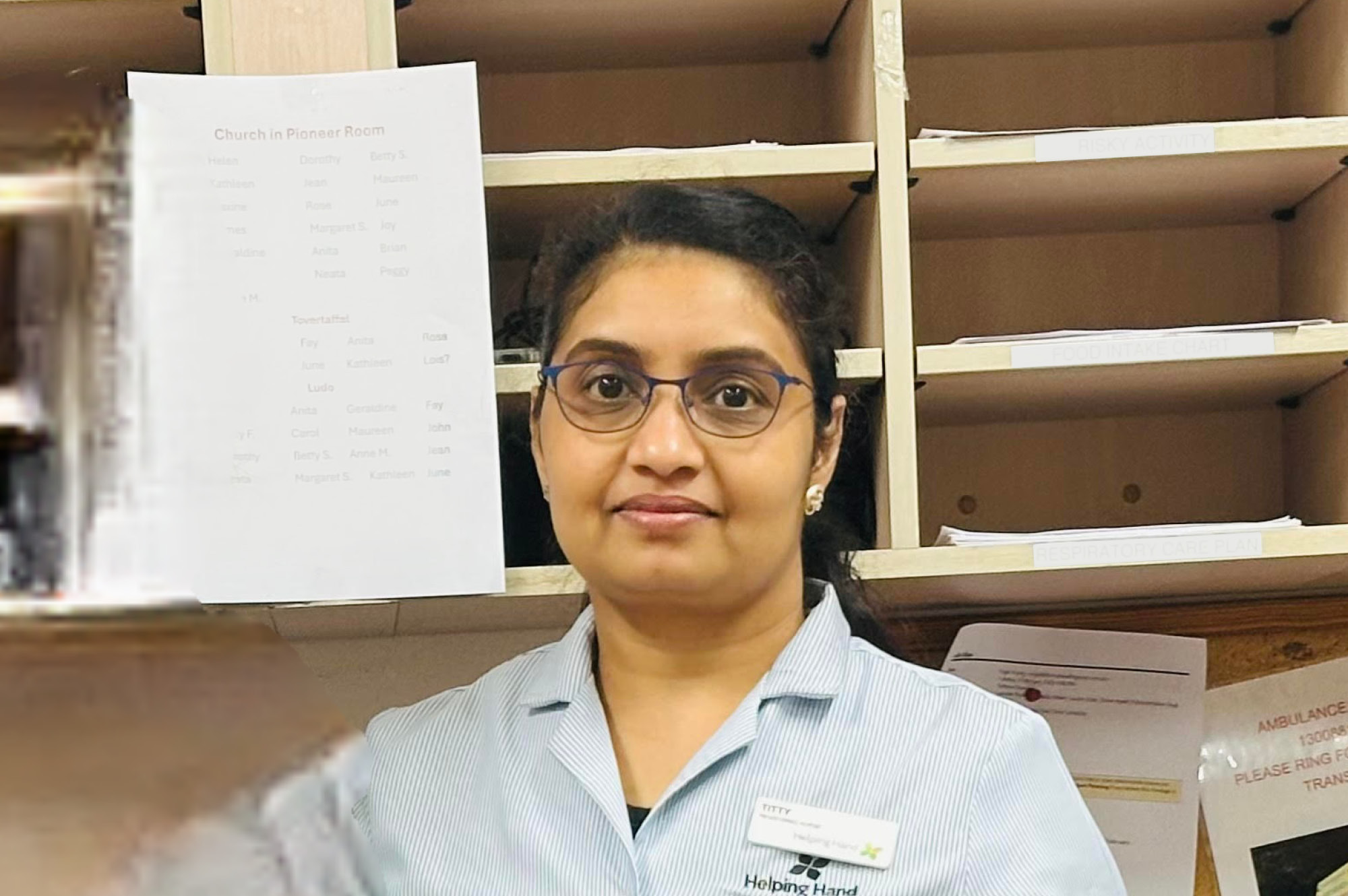
It’s a long way from the oil-rich gulf country Kuwait to Jamestown, alongside rivers, forests and farms, north of Adelaide. Yet Registered Nurse Titty Mol Antony has done just that with her family – moving from the Middle East to the Mid North.
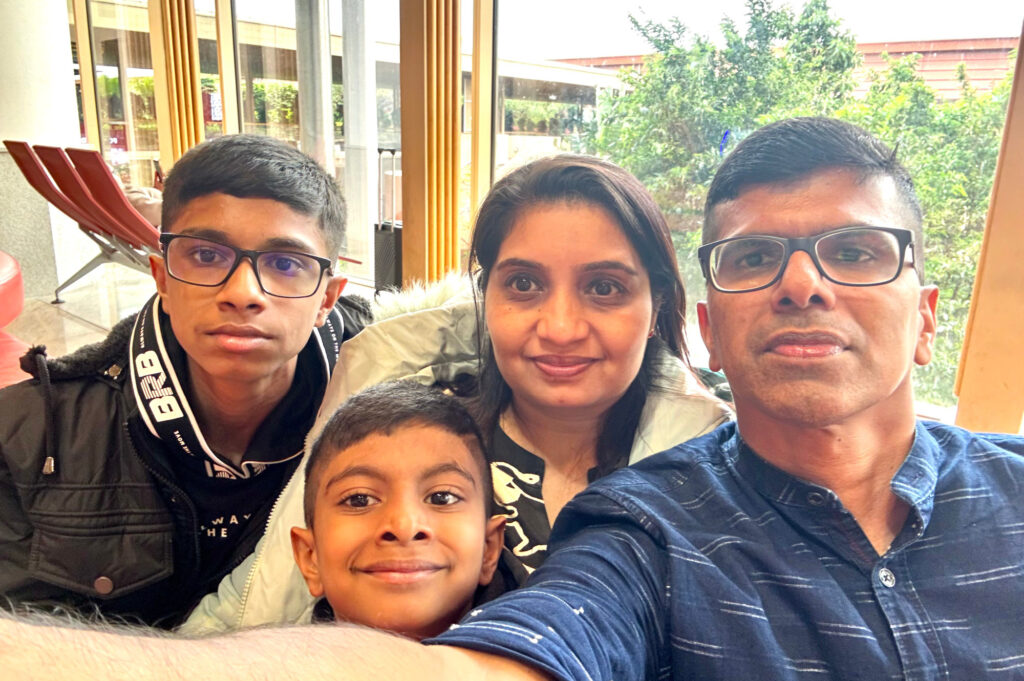
Having been a nurse for 21 years, including 13 years in Kuwait, Titty moved to New Zealand to complete the Competency Assessment Program (CAP) in 2024. She obtained her New Zealand registration, which also enabled her to gain her AHPRA registration in Australia. Interested in working in aged care in Australia, Titty worked with Australian Migration and Recruitment Consulting in Melbourne, which identified and liaised with Helping Hand as a potential employer. Helping Hand was then able to support her visa application, along with supporting her accommodation and basic moving needs. With her husband and two sons, aged 14 and 8, she arrived in South Australia ready to become part of her new community.
“The community has been very welcoming and supportive, which has helped us feel comfortable quickly,” Titty said. “Since arriving, we have been actively involved in the local community through St James Catholic Church. We attend regular church services and participate in various church activities. We also enjoy joining in community celebrations, such as joint Christmas events and other festivals, which help us feel connected and part of the town.”
Moving from Kuwait – which has a population of about 4.8 million – to Jamestown – with a population of fewer than 1,400 people – has been a breath of fresh air for the family. Life was busier in Kuwait, which often comes when you’re living in a bustling, high-tech city.
“Here, it is much quieter and more peaceful, which we really appreciate as a family. The calm environment makes it a great place to relax and spend quality time together,” she said. “What I enjoy most about living in a regional community is the peaceful and quiet environment. There is less traffic, very low crime, fresh air, and beautiful natural surroundings.”
Both of her boys are settling in well. Her older son is studying at St Mark’s College in Port Pirie, while her younger son is at St James Catholic School in Jamestown.
“The students and staff have been very friendly and supportive, which has helped them feel comfortable and happy at school.”
Aside from living in a completely different culture and climate, Titty has embraced her working life in aged care. As a hospital worker in the past, she now fills the role of an RN and has higher responsibilities at Helping Hand. Her role is more independent than it was with previous employers, and unlike hospitals, there are no doctors on-site, or supervisors overseeing her work.
“This has allowed me to develop my decision-making skills and build closer relationships with residents, which is very rewarding.”
She appreciates working in aged care because it has given her the opportunity to spend more time with older people, helping with their needs and providing companionship to ease their loneliness. She is embracing her working life in Jamestown, where she enjoys working with her colleagues, finding them “supportive, friendly and approachable, which makes teamwork smooth and enjoyable”.
“Life in a regional area is peaceful, safe, and family-friendly and it offers a great work-life balance. With the right support, like Helping Hand provides, settling in is much easier than you might expect.” While she hasn’t quite settled into the “vegemite on toast” breakfast diet, Titty and her family have so far enjoyed eating out locally, in Port Pirie and in Adelaide, where they have been able to find their favourite foods.
Life is sounding quite comfortable and settled for Titty and her family, and she is encouraging others to follow her lead and move to a regional community. While it might be that little bit quieter, it has been all-the-more rewarding.
Home/Helping Hand commits to strengthening quality aged care in Whyalla
Artists impression of Copperhouse Court extension– external
Helping Hand has announced plans to commence upgrades and to its Copperhouse Court and Yeltana residential aged care homes this year, providing more quality care for local residents.
The announcement has come with a funding boost from the Albanese Government, which has grown $22M to allow for a rise in costs and materials.
Helping Hand Chief Executive Officer Chris Stewart said, “We’ll be taking a careful, phased approach with construction expected to begin before the end of 2025. No residents will be asked to move out during the development. Each phase is being thoughtfully planned to ensure the number of available rooms stays the same throughout, in recognition of the strong demand for aged care beds in Whyalla. We’ll also work hard to minimise noise and disruption, while continuing to provide the high-quality care our residents rely on.”
The upgrade will provide a total of eight new rooms across the two sites, providing more rooms for older people in need.
The funding will help provide:
Yeltana
A new wing
An upgrade of all shared rooms to individual rooms with ensuites (no shared bathrooms)
A new dining area and multi-purpose activity space
An upgrade of electrical systems
New courtyard with BBQ and water feature
Copperhouse Court
Additional rooms
A flexible multi-purpose space for activities
An upgrade to rooms and amenities, including painting and flooring
Landscaped and sheltered external areas.
Artists impression of upgraded Copperhouse Court internal area
The long-term benefits of this upgrade are immense as Helping Hand remains the only residential care provider in Whyalla and one of the biggest employers. Mr Stewart continued, “this funding is allowing us to expand our services and ensure that more Whyalla residents will have access to quality care locally and be able to spend their final years close to their family and community.”
“Just as importantly, thanks to the support of the Albanese Government, we will provide rooms and amenities that deliver on dignity, safety and privacy.
“Our plan is to increase capacity at our Copperhouse Court care home and upgrade all shared rooms to individual rooms with private ensuite bathrooms in our Yeltana care home, which is beneficial for infection control. Both care homes will also have new multi-purpose spaces which will offer increased opportunities for social connection – which we know is so important for ageing well.”
“Residential aged care will always have a place in the community, and as the population of older South Australians increases, we need to make sure we keep up with improving the quality of the care available in regional communities,” Mr Stewart said.
Helping Hand has appointed Kennett Builders to deliver the project, having worked successfully with them on previous regional developments in Jamestown and Port Pirie. Kennett Builders, General Manager, Anthony Carbone said, “We’re committed to using local trades wherever possible for this project, which means this investment will create real opportunities for local tradespeople in Whyalla. We see building strong partnerships with local contractors as absolutely key to the success of this development.”
Helping Hand would also like to acknowledge the City of Whyalla for their support and excellent engagement since joining the community.
Supporting Allied Health students in Whyalla
As part of its ongoing commitment to expand aged care services in Whyalla, Helping Hand will start sponsoring UniSA allied health students in the local community. Two students, one from Occupational Therapy and one from Physio will be sponsored per year, for three years. The funding would focus on students that are financially and/or educationally disadvantaged.
Background on Helping Hand in Whyalla
Kindred Living transitioned to Helping Hand in November 2022. Since then, Helping Hand has been determined to build on the legacy created by Whyalla locals to assist older and vulnerable people to remain living in their community as they age. Aged care services in Whyalla were established by the local community and since first being invested into in 1968 have continued to grow.
“At Helping Hand, we take the responsibility to honour this history, and to continue this legacy, very seriously. We’re delighted that we have been able to secure this funding to develop and enhance the aged care services available to regional South Australians,” Mr Stewart said.
First, they prepared to say goodbye. Next, they wrote a screed to the doctors and hospital begging to bring him home. Now, about a year later, Daryl’s family is in awe of the health improvements brought about through Helping Hand’s Allied Health services. Daryl is living at home with his beloved wife Sue and regaining strength and capability.
Not long before the first of four medical episodes, Daryl had undergone a medical assessment for work. As usual, the report was essentially ‘fit as a fiddle’ which made the sudden decline in his health incredibly difficult for everyone to comprehend. As his stepdaughter Chelsea explains, ‘he was the one that could do anything and who would do anything for anyone’.
‘Daryl was always “Mr Fix It”. To see him change was incredibly challenging because in many ways he lost his identity. But he never lost his spirit or his character. To see his strength increase, and to see him at his easel painting again, is the most heartening thing for all of us. My Mum is now a 24/7 carer. Her life has also changed completely. Daryl improving means that her life is also a little bit easier and that’s a huge relief for me.”
When Sue first met Daryl, it was at the swimming pool, a location that featured heavily in Daryl’s life. Growing up, he was more interested in sport than school and diving was his passion. He left school early, much to his parents’ disappointment, and got a job packing shoes. That ended quickly due to him getting caught taking time off to go diving. His talents were significant. He earned himself a sports scholarship and eventually a worldwide reputation as a coach, judge and competition manager. He is responsible for setting up a successful diving community in Singapore. Daryl didn’t only make a splash in the diving world (a small one in the pool, of course) he also became South Australia’s first ever male house mother, having completed a diploma in social work.
He’s also a painter and in keeping with his rich and interesting existence, Daryl found out at age 54 that he had been adopted and he is Aboriginal.
Daryl is most likely to claim meeting Sue as one of his greatest achievements. The day she brought her daughter Emma across town for a competition, laid eyes on Daryl and subsequently fell in love, both their lives changed for the better. Sue talks about their shared life with much joy and pride.
‘When I met Daryl, he’d spent eight years raising three boys on his own. We became the Brady Bunch after a while and have had a wonderful life. We both became involved with diving and after we retired in 2013, we lost our hearts in Cambodia. We got involved in a small rural community, relishing the chance to do something to help. While we were still being flown back to Singapore to help run diving programs, we would add on a trip to Cambodia and spend six months there volunteering.’
Such is their commitment and kindness that both received Order of the Medal of Australia in 2019 for services to diving and Cambodia.
Unfortunately, in 2020 Daryl’s health meant their packed bags would go nowhere. He experienced two strokes, brain seizures, time in a coma and a lengthy stint in ICU. His recovery was slow and emotionally challenging. He was often cold and listless and disheartened by his inability to do things such as connect brush to canvas even with ideas at the ready. Thankfully, he was living closer to town (at the request of his children) when hit by another episode of brain seizures. Two months later, after the family demanded he come home from hospital, he was assessed and awarded a Home Care plan.
Daryl is a big fan of his Exercise Physiologist Harry Beresford and very grateful for all the treatment and support he receives through the plan.
‘The team has been fantastic. I see them twice a week and do my exercises for strength and standing. The change is unbelievable. I can shut my eyes and stand and not fall.’ Which Daryl does while explaining his progress, grinning from ear to ear as he stands and sits repeatedly.
‘I can’t believe how well I’ve got in such a short time. I can go back to painting. I can put clothes on. It’s just so good that I can do so many things. Exercises have helped with coordination and my brain is getting better too.’
Both Chelsea and Sue credit Helping Hand’s Allied Health team for the huge turn around in Daryl’s quality of life. Sue will admit that she was a bit reluctant to hand over control at first but that the change is immeasurable.
‘Daryl’s now going back uphill as opposed to backwards. And the help I get is massive as I’m now having to do the stuff that Daryl used to, like cooking.’
Sue and Daryl get house cleaning and gardening help. Every six weeks Sue sees a podiatrist and she also has her own physio sessions which is excellent for preventative health. No services are outsourced and there are more they can access as required which makes Chelsea, a Helping Hand staffer herself, feel exceptionally proud.
Sue says Home Care is ‘just as the word says. It cares for you and allows you to stay home and live your best life.’
Then Daryl chimes in, wrapping his arms around both Chelsea and Sue, exclaiming with tears in his eyes how he couldn’t live without them helping him too.
And Daryl’s right, family support means a lot. The interview may have taken place over Facetime, but the love and care in this family is still palpable. In fact, by the time you read this, the extended family will have escorted Sue and Daryl back to Cambodia for a visit, as their own team.