Across Australia, an estimated 446,500 people are currently living with dementia (Dementia Australia, 2026). This number is expected to rise by more than 80 per cent, to 812,500 people by 2054.
As Australia’s population ages, demand for dementia care will continue to grow as more people living with dementia enter aged care. This means providers need to ensure dementia care sits at the heart of the everyday services they provide.
At Helping Hand, delivering meaningful, person-centred dementia care that puts individual needs and preferences first is a key focus of our 2025–2030 Strategic Plan and a shared passion amongst staff, including Graham Harding, Residential Services Manager at Helping Hand North Adelaide.
Our staff play a vital role in providing safe, consistent care that supports residents and families through every stage of the dementia journey.
“People living with dementia are full and complete human beings, with the same value as anyone else,” Graham said.
“To me, excellent dementia care is about creating quality experiences that provide comfort in the moment, that spark joy, support a sense of achievement and enable as much freedom as possible. It’s about time in nature, exercise, and connection to community. Moments that stay with a person for days or even weeks.”
Reflecting on his time working directly as a carer in Memory Support Units (MSU), Graham recalls the small, everyday moments that can have a lasting impact.
“I can remember supporting a resident who was feeling unsettled by taking her outside into the garden. We walked together on the grass with our shoes off, giving her the chance to reconnect with nature. She hadn’t felt something like grass or sand beneath her feet in years, and that moment made a real difference – for her on the day and for our relationship in care.”
With a career in aged care spanning over 27 years, Graham has worked in various organisations and across a wide range of roles, from kitchen hand and personal carer to leadership positions in both metropolitan and regional areas. This breadth of experience has shaped his approach to care and leadership, grounded in putting the individual first and moving beyond labels to improve care and service delivery outcomes.
While his professional experience has strongly influenced his perspective, Graham’s commitment to dignity of care, particularly for those living with dementia, is also deeply personal.
“My nana lived to 91. She was an incredibly strong woman who raised seven children and later cared for five of her grandchildren well into her 60s and 70s,” he said.
“In her later years she developed dementia, and I saw firsthand how the care my mum, along with that of the carers and nurses, supported her to live her best life. Their gentle touch, kind words and patience would bring moments of clarity, where she’d say something unexpectedly sharp and witty.”
Reflecting on both his personal and professional journey, Graham wrote a poem (pictured below) capturing the humanity of dementia care and the important role staff play in supporting dignity, connection and understanding.
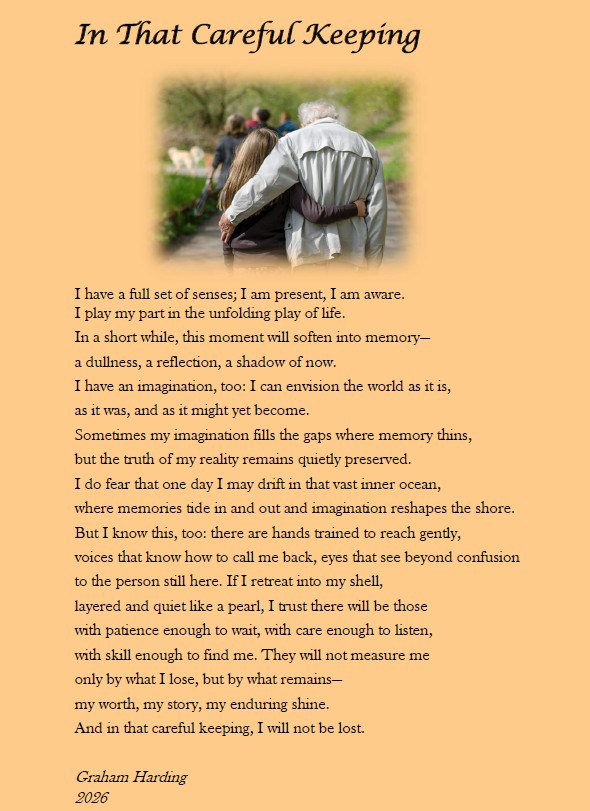
“I really dedicate the verse ‘…hands trained to reach gently, voices that know how to call me back, eyes that see beyond the confusion to the person still there…’ to all the amazing staff who have chosen to work in this challenging yet incredibly rewarding career,” Graham said.
At Helping Hand our dedicated staff work closely with the families of those living with dementia to build care around each person, ensuring it is tailored, respectful and grounded in what matters most to them.
For families, this level of support can be life changing. It allows loved ones to step back from the day-to-day demands of being the sole carer and focus on simply being a partner, child or friend again, returning to the everyday pleasures of sharing a coffee, a walk or quality time together.
“One thing I have learned over the years is that when you are fully present in your role and use kind and skilful conversation, it not only brings comfort and encouragement to residents, but it also energises you. Small acts of kindness can be incredibly uplifting as well.”
Graham also believes that some of the most important moments, when providing care, can often be simplest.
“If I could share one message to those working with people living with dementia, it’s this: before you start any task or activity, take the time to make a human connection,” he said.
“When you enter someone’s room, sit beside them, make eye contact at their level, and ask how they would like to start their day, or how you can help make it a good day for them and whether they are okay with you being in their space right now”
“It’s the small things, like taking a moment to have a conversation, that can completely change the care experience.”
Graham also emphasised the importance of having regular, open conversations about dementia care, outside of and in the lead-up to Dementia Action Week (21–27 September).
“Having these conversations helps keep the focus where it belongs, on maintaining dignity and providing the support people need,” he said.
“Brain health is also becoming an increasingly important topic in the wider community, as changes in the brain can occur years before there are any visible signs of dementia.”
Click here to learn more about how Helping Hand supports people living with dementia and their families.